
Pest Control PPC: The Home Service Industry Guide to Paid Ads in 2025

PPC advertising has become the primary lead generation channel for lawn care and pest control companies. This guide shows you exactly which paid platforms drive ROI and how to maximize every advertising dollar.
Key Takeaways
- PPC generates 2x more visitors than SEO: Paid ads dominate search results—businesses not investing in PPC lose ground to competitors
- Multiple platforms matter: Google Ads, Local Services Ads, Performance Max, and Microsoft Ads each serve distinct roles in a comprehensive strategy
- AI transforms ad management: Performance Max and AI-powered tools automate optimization across channels while reducing manual workload
- Track revenue, not just leads: Successful companies target 3:1 ROI, measuring actual revenue per dollar spent on each platform
- Mobile optimization is critical: 70%+ of ad clicks come from mobile devices—landing pages must load fast and convert on smartphones
The PPC landscape for lawn care and pest control has evolved dramatically. While Google Ads was once the only game in town, today's successful companies leverage multiple paid platforms strategically. Understanding which channels deliver results and how to optimize each one determines whether your advertising budget generates profit or waste.
When it comes to paid advertising, it's not about being on every platform; it's about being on the right platforms with the right strategy. So which paid channels deliver the best ROI for pest control and lawn care companies?
The answer depends on your customer base, budget, and regional market dynamics. To compete effectively, you need to understand how each PPC platform works and where your ideal customers are searching for solutions.
The Expanding Paid Lead Generation Landscape
The percentage of leads from paid sources has increased as the search engine results page landscape has changed dramatically over the last few years. Paid ads dominate the top of the page, meaning there's a lot of competition to contend with if you're not paying to play.
In fact, a 2023 study by Wordstream found that PPC generates twice as many website visitors as SEO.
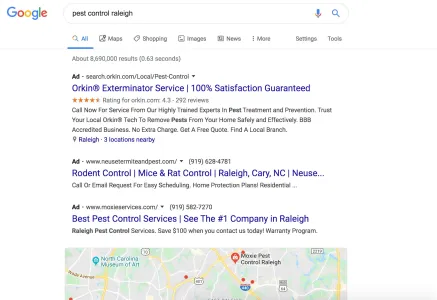
Searches for local businesses often generate a results page that doesn't show traditional organic listings until you've scrolled halfway down the page!
Eight years ago, if you had a paid strategy at all, it likely revolved exclusively around Google PPC ads.
As more businesses have entered the Google Ads arena, bids for top revenue-generating keywords have increased, along with competition for real estate at the top of the search engine results page. While this is still where you'll have the greatest reach, pest control and lawn care companies that were achieving a #1 or #2 spot four years ago may be paying more per click to maintain that position today.
With over 3.5 billion daily searches (Want to see today's count?), Google continues to dominate the search industry, but today, Google Ads is far from the only player in the game.
Google Ads (Search Campaigns)
Google Ads remains the foundation of most successful PPC strategies. With the highest reach and the ability to capture customers at the exact moment they're searching for your services, Search campaigns are essential for any pest control or lawn care company serious about growth.
As more businesses have entered the Google Ads arena, bids for top revenue-generating keywords have increased. Companies that secured #1 or #2 positions four years ago may find themselves paying more per click today to maintain those rankings—but the investment remains worthwhile due to the quality and volume of leads generated.
Key Considerations:
- Highest reach and intent-based targeting available
- Requires ongoing management and optimization
- Competition has increased costs for top keywords
- Essential foundation before expanding to other platforms
Performance Max Campaigns
Performance Max (formerly Smart Shopping and Local campaigns) represents Google's AI-driven approach to advertising across all Google properties—Search, YouTube, Display, Discover, Gmail, and Maps—in a single campaign. Recent updates have added channel-level reporting and campaign-level negative keywords, addressing earlier transparency concerns.
Pros:
- Automated optimization across all Google channels
- Particularly effective for businesses with store/office locations
- AI-driven asset testing and audience targeting
- Increased transparency with 2025 reporting updates
Cons:
- Less granular control compared to traditional Search campaigns
- Works best as a complement to, not a replacement for, Search campaigns
- Requires quality conversion tracking to perform effectively
Local Services by Google
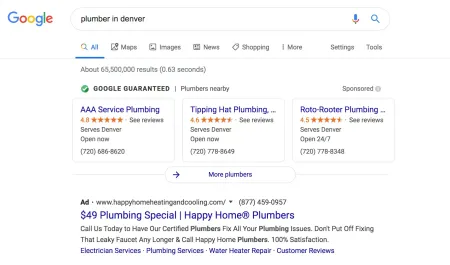
Designed specifically to support searchers seeking local solutions, Google Local Services caters to home service industries such as pest control, plumbing, and HVAC. Google's Local Service ads appear above traditional paid ads for relevant searches.
Instead of a text ad that directs searchers to a landing page, a Local Service ad will show only a business's name, phone numbers, hours, ratings, and reviews. These ads are also serving as the primary responses to voice search requests via the Google Assistant.
Unlike Google Ads, Local Services by Google Ads operates on a pay-per-lead model rather than pay-per-click.
Pros:
- More easily tied to location, allowing you to access your specific markets without keyword research, a technical background, or landing pages.
- Google now automatically credits businesses for poor-quality leads, saving time on manual disputes.
- Able to dispute unqualified leads (though automated credits have replaced some manual dispute options).
- Google Screened or Guaranteed badge builds trust
- Prime positioning at the top of search results
- Primary response channel for voice search through Google Assistant
- Now appearing in the Google Maps app on iOS for additional visibility
Cons:
- Not currently available for lawn care, and not available in all markets for pest control (yet!)
- Proximity and reputation are primary ranking factors, making it difficult for companies with low Google Business Profile ratings to compete.
- Google no longer provides credits for "job type not serviced" or "geo not serviced" leads—accurate service area and job type configuration are critical to avoid budget waste.
- Some specialized services (like wildlife control) have limited or no LSA coverage, requiring traditional PPC for certain search terms.
Important note: Ensure your service area, verticals, and job type settings are accurately configured in your LSA dashboard. With automated credits replacing some manual dispute options, proper setup is essential to prevent spending on unqualified leads.
Microsoft Ads
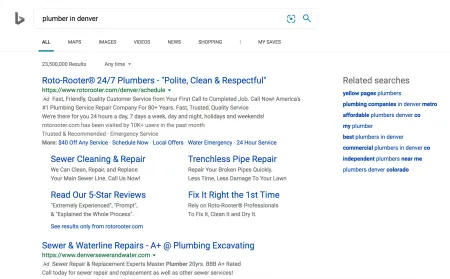
"The other white meat" of the search industry, the Microsoft Search Network comprises Bing, Yahoo, AOL, and partner sites.
While it may not have the same reach as Google Ads, Microsoft reaches a significant chunk of your target market that typically doesn't cross over to other search engines.
The Microsoft Search Network also has a slightly older, more educated user base than Google, meaning searchers are more likely to have buying potential, especially if your pest control company operates in a market with an older population than others.
Pros:
- The ad management platform mirrors Google Ads, making it easy to duplicate campaign setup and strategy if you're already using Google Ads.
- Competition is lower (most small businesses prioritize Google first), so clicks for revenue-generating keywords are often cheaper, and click-through rates can be higher.
Cons:
- Like Google Ads, it requires time, attention, and technical strategy that small business owners often don't have.
Paid Social
There are nearly 1.5 billion users spending, on average, 41 minutes per day on Facebook.
While we've seen paid social channels have limited impact on driving leads—people on Facebook aren't often looking to buy while they're using the network and have much lower purchase intent than a Google searcher—these channels have proven themselves as a useful supplement to other advertising.
By increasing awareness and building reputation, Facebook and other social advertising can help pest control and lawn care companies with larger budgets brand themselves and maximize ROI on their investments in other channels.
Pros:
- Investment in paid social channels typically increases the click-through rate for ads on other platforms.
- Can be useful in non-lead generation efforts (For example, hiring or special offers, cross-selling to existing customers)
Cons:
- Often disconnected from ROI, businesses with limited marketing budgets should focus on other platforms first to move the needle.
The Importance of Mobile-Optimized Landing Pages
With over 70% of ad clicks coming from mobile devices, your landing pages must be optimized for smartphone users. Even the best PPC campaign fails if your landing page doesn't convert mobile visitors.
Essential mobile optimization elements:
- Fast load times (under 3 seconds)
- Click-to-call buttons are prominently displayed
- Simple, short forms (3-5 fields maximum)
- Clear value propositions above the fold
- Legible text without zooming
- Large, tappable buttons
Google prioritizes mobile experience in Quality Score calculations, directly affecting your ad costs and positions. A poorly optimized mobile landing page increases your cost-per-click while decreasing conversion rates.
Coordinating Multiple PPC Channels
Running campaigns across multiple platforms requires coordination to maximize results while avoiding budget waste.
Best practices for multi-channel PPC:
- Start with Search campaigns: Build foundational keyword data before expanding to Performance Max
- Layer platforms strategically: Use Local Services Ads for top-of-page presence, Search for intent-based targeting, and Performance Max for broad reach
- Avoid channel cannibalization: Monitor search term overlap between campaigns to prevent bidding against yourself
- Unified tracking: Implement consistent conversion tracking across all platforms to compare performance accurately
- Budget allocation: Start with 60-70% in Search, 20-30% in Performance Max or LSA, 10% in Microsoft Ads for testing
Performance Max works best as a complement to Search campaigns, not a replacement for them. The AI learns from your Search campaign data to optimize Performance Max delivery.
Measuring Paid Ad ROI
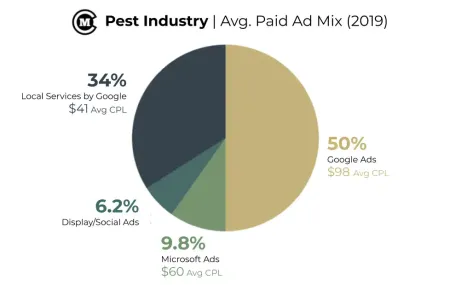
At Coalmarch, we're constantly testing and measuring performance for our Digital Marketing clients, both to improve the performance of their ad campaigns on each platform and to help them understand where their budget is best utilized.
It's critical to track the right KPIs so you can invest in the channels that are driving ROI.
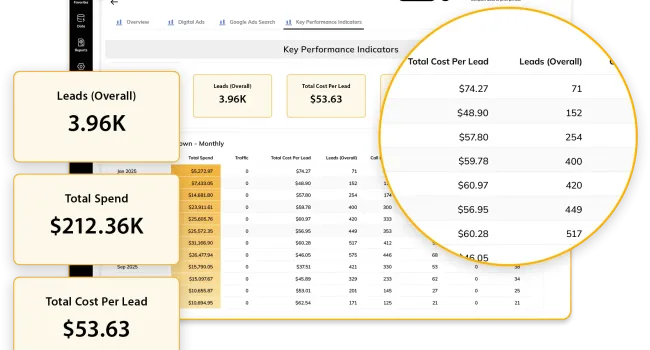
Our team tracks spend, traffic, clicks, conversions, and year-over-year performance to better understand how certain keywords perform over time, which landing pages are converting visitors, and which markets are driving results for your business.
Critical metrics we monitor:
- Spend and cost-per-lead by channel
- Traffic sources and user behavior
- Click-through rates and conversion rates
- Year-over-year performance trends
- Keyword performance over time and by season
- Landing page conversion rates
- Geographic market performance
- Revenue attribution by marketing channel
Most successful pest control and lawn care companies target a 3:1 return on marketing investment—meaning every dollar spent on advertising generates three dollars in revenue.
Building Your PPC Strategy: A Phased Approach
Success requires a strategic, phased approach rather than launching on every platform simultaneously. Consider this framework:
Phase 1: Foundation (Months 1-3)
- Google Ads Search campaigns targeting high-intent keywords
- Conversion tracking implementation
- Mobile-optimized landing pages
- Baseline performance data collection
Phase 2: Expansion (Months 3-6)
- Google Local Services Ads (where available)
- Microsoft Ads for additional market coverage
- Campaign optimization based on performance data
- Negative keyword refinement
Phase 3: Advanced Automation (Months 6+)
- Performance Max campaigns
- Remarketing campaigns for website visitors
- Paid social for brand awareness (optional, budget permitting)
- Cross-channel optimization
Phase 4: Continuous Optimization
- A/B testing of ads and landing pages
- Seasonal campaign adjustments
- Geographic performance analysis
- Budget reallocation based on ROI data
Common PPC Pitfalls to Avoid
Using broad match keywords without proper negatives: Broad match can waste budget on irrelevant searches. Always build comprehensive negative keyword lists, especially for terms like "free," "DIY," "jobs," and "salary."
Ignoring mobile performance: Over 70% of clicks come from mobile devices. If your mobile conversion rate lags desktop, fix your landing page experience immediately.
Setting and forgetting campaigns: PPC requires ongoing optimization. Competitors adjust bids, search trends shift, and seasonal patterns change throughout the year.
Poor Quality Score management: Low Quality Scores increase your cost-per-click. Focus on ad relevance, landing page experience, and expected click-through rate to improve scores.
Not tracking phone calls: Many pest control and lawn care leads convert via phone. Without call tracking, you're blind to a significant portion of your conversions.
Bidding on competitor names without a strategy: Competitor keyword bids are expensive and often low-converting. Only use this tactic if you have a clear competitive advantage to highlight.
Neglecting ad extensions: Callout extensions, sitelink extensions, and structured snippets improve click-through rates and ad visibility at no extra cost.
Geographic targeting is too broad: Advertising outside your service area wastes budget. Use radius targeting around your locations or define specific ZIP codes you serve.
Ready to Level Up Your PPC Campaigns?
If you're a small business owner who is ready to level up your business with paid advertising and are looking for a partner who can help you drive results, give us a shout!
At Coalmarch, we specialize in helping lawn care and pest control companies maximize their PPC performance across all platforms. Our team brings deep expertise in:
- Google Ads Search campaign management and optimization
- Local Services Ads setup and lead dispute management
- Performance Max campaign strategy and AI-driven optimization
- Microsoft Ads deployment for expanded market reach
- Landing page conversion rate optimization
- Comprehensive tracking and ROI reporting
We don't just set up campaigns and walk away. We're constantly testing, measuring, and refining your advertising strategy to ensure every dollar works as hard as possible for your business.
Whether you're just getting started with PPC or looking to improve underperforming campaigns, our team can help you navigate the complex paid advertising landscape and drive the leads your business needs to grow.
Contact us today to discuss how we can help you dominate your local market with strategic paid advertising.
This guide is updated annually to reflect the latest PPC platform changes and advertising best practices. Last updated: 2025


Marketing your home services business without tracking ROI is like driving with your eyes closed. Every dollar you invest in digital marketing should drive measurable results but most pest control and lawn care companies struggle to connect their marketing spend to actual revenue - especially in a rapidly changing digital environment where AI-driven search results and zero-click conversions make it even more difficult to see the full story of your ROI.

Marketing your home services business without tracking ROI is like driving with your eyes closed. Every dollar you invest in digital marketing should drive measurable results, but most pest control, lawn care, and HVAC companies struggle to connect their marketing spend to actual revenue.